What I Know
I know I was sexually abused by men in my family when I was a young girl.
I know at least one of those men raped me.
I know I didn’t know what sex was at the time.
I know it felt like I was being eviscerated.
I know I believed the man raping me was actually killing me.
I know I spent many nights as a child in abject terror, lying alone in my bed.
I know I was waiting for a man to come kill me.
I know I practiced holding my breath so that when he found me, he would think I was already dead.
I know the man I feared was already in the house with me.
I know I was sexually abused by men in my family when I was a young girl.
I know at least one of those men raped me.
I know I didn’t know what sex was at the time.
I know it felt like I was being eviscerated.
I know I believed the man raping me was actually killing me.
I know I spent many nights as a child in abject terror, lying alone in my bed.
I know I was waiting for a man to come kill me.
I know I practiced holding my breath so that when he found me, he would think I was already dead.
I know the man I feared was already in the house with me.
I know I showed injuries to an adult I trusted.
I know that adult helped me ice my injuries.
I know I received no other form of intervention or help.
I know that as a child I needed to believe my parents were good people who loved me.
I know that not knowing about the abuse saved my life.
I know being abandoned in the trauma harmed me more than the abuse itself.
I know the silence and denial in my family made it impossible for the truth of what was happening to me to be known.
I know how insane that made me feel.
I know that I survived and am sane.
I know that my body and trauma symptoms have long been telling the truth.
I know my parents did not love and protect me in the ways I needed them to, and I know that was never about me.
I know the people who harmed me will not take responsibility, and I know how hard that is to live with.
I know how lonely and scary it is to choose myself and the truth, and risk losing belonging.
I know the shame of having been sexually abused and raped as a child is not mine to carry.
I know my well-being was sacrificed to keep that shame secret.
I know the insides of grief and rage.
I know that I require truth to live, and I know this is not true for everyone in my life.
I know how denial tries to erase my own knowing.
I know how to find my way back to reality through my body and my symptoms.
I know how to hold the terrorized, traumatized child inside me without needing her fear to be any less.
I know my body saved me twice—first when I believed I was dying, and after, when I couldn’t survive knowing about it.
I know to believe my body.
I know how to let little drips of pleasure in, and when pleasure makes me dissociate, I know how to care for myself as I return to my body.
I know my daughter is safe.
I know how to say, “I’m sorry,” and, “Thank you.”
I know how to be accountable for harm I cause, and I know how to show up in repair.
I know that boundaries are how I stay safe in my adult relationships.
I know I am not alone, even when I’m brutally alone.
I know I am loved.
I know how to dance like my body is a living prayer.
I know how to create beauty, and I know how to revel in it.
I know the feeling of love cracking my heart wide open, and I know the terror that almost always follows.
I know what it is to grieve an entire life.
I know how to celebrate that same life.
I know it was the offerings of strangers—their music, art, writing, wisdom and teachings—that held me when I had no one else and helped me come back to myself and life.
I know how to pray to Goddess and listen to spirit and ancestors.
I know I am alive, and I know how miraculous my life is.
I know that my healing is unending, and that what I know will continue to change.
Daughter Letter 2, For the Child She Is
This piece is part of The Daughter Letters—a series of love letters written from the perspectives of mother, daughter, divine child, and divine mother.
I read this to my daughter before it was shared with anyone else. Shared with consent.
Hi sweet girl,
You are right that a lot of people do not understand you, but that is not your fault. Even I—your mama, who loves you so freakin’ much—sometimes don’t understand you. And I know that hurts you. I am learning how to be your mom by being your mom, and that can be hard for both of us sometimes.
You are a little ahead of us. You haven’t learned to hide as much of yourself as we have.
Because of that, we sometimes treat you like you are bad or wrong—like you should have to hide those parts of you too. We have made you feel small and scared. Sometimes we’ve made you feel like it’s not okay to be you, like you shouldn’t exist. But we are the ones who are wrong, my darling.
This piece is part of The Daughter Letters—a series of love letters written from the perspectives of mother, daughter, divine child, and divine mother.
I read this to my daughter before it was shared with anyone else. Shared with consent.
Hi sweet girl,
You are right that a lot of people do not understand you, but that is not your fault. Even I—your mama, who loves you so freakin’ much—sometimes don’t understand you. And I know that hurts you. I am learning how to be your mom by being your mom, and that can be hard for both of us sometimes.
You are a little ahead of us. You haven’t learned to hide as much of yourself as we have.
Because of that, we sometimes treat you like you are bad or wrong—like you should have to hide those parts of you too. We have made you feel small and scared. Sometimes we’ve made you feel like it’s not okay to be you, like you shouldn’t exist. But we are the ones who are wrong, my darling.
You are more real, more honest, more feeling and all of that is GOOD. Your feelings are never wrong. Who you are is beautiful and perfect, exactly as you are.
You are so alive, vibrant, and BIG, and it is wonderful you are this way. You are like Goddess herself—full of love and power. You are more of what I am trying to be.
All your ancestors who tried their very best did it so you could exist. They wanted you to be more yourself than they got to be. And here you are—so gorgeously you. You are the hope and wishes of every mother who has come before you. We want you here exactly as you are.
But I know that is not how we make you feel all the time. Because you don’t hide all of what we were taught to hide, we blame you. We show you that we think you should be different than you are—more like who we have had to be. You have noticed this. This is why you feel like you are bad and wrong.
You feel like you shouldn’t exist because we have made you feel that way. I have made you feel that way. Then, we made it seem like you feeling that way is wrong. We hurt you, and then we acted like you being hurt was your fault. It’s really confusing and can feel scary.
I am so very sorry.
Even as we adored you, we made you feel unlovable. Even as we wanted you, we made you feel like you didn’t belong here. Even as we delighted in you, we made you feel like you are bad. We failed you, my sweet girl, but we made you feel like you are failing us. That is so unfair.
Shame is the feeling we have when we feel like who we are is wrong. We have made you feel like who you are is wrong, and in doing that, we gave you shame. You are carrying it in your body as if it is yours, but it is our shame you are holding. It is the shame my mother gave me, and that I have now given to you. I would like to take it back.
I never wanted you to feel bad, wrong, or like you shouldn’t exist. I hoped to protect you from those painful feelings. But I couldn’t. I am mothering myself as I mother you, and that means I still sometimes act like you are bad or wrong. I also hope you can see what I am doing well. There is so much good here too.
You are helping me to grow, and I am willing to grow for you. I have learned that what I push away in you is what my mom pushed away in me—and I have told you this. I am telling you the truth. I am learning how to love all of who I am so I can love all of who you are. I have hurt you, and I am here: saying I’m sorry, loving us both, and showing you how to be a caring human who makes mistakes and stays connected anyway.
I am becoming a mother who hasn’t existed before. You will do even better than me.
I love you as big as the universe. I want to help you stay close to who you really are. I will keep learning and growing. I will get bigger so I can be the one holding your bigness.
You belong here on this planet. You are human like the rest of us. You are who the world most needs—the very best of all of us.
I hope you can start to believe in yourself. I hope you can see your beauty like I do.
I love you so much my darling girl.
All of my love,
Mama
Love Letter 27: Tenderness, Devotion, Presence
My Sweet [Recipient’s Name],
I wish I was there right now, sitting in front of you, gazing back softly. My smile would widen tenderly like a bud unfurling. We could be in the quiet together. I might start to cry, my love for you cracking my heart wide open. I would ask to hold both of your hands in mine. We could sit knee to knee and hand in hand, breathing the same air. It would be as if a prayer came to life.
I would tell you the million things that make you incredible to me. I would use the whole of my being to reflect back to you how gorgeous and magnificent you are. My words could wash away all the doubts you have that you are anything less than perfectly beloved. I would say, if you needed me to, that you will always be okay. Always. If you started to weep, you could see in my face that I know exactly how you are feeling.
My Sweet [Recipient’s Name],
I wish I was there right now, sitting in front of you, gazing back softly. My smile would widen tenderly like a bud unfurling. We could be in the quiet together. I might start to cry, my love for you cracking my heart wide open. I would ask to hold both of your hands in mine. We could sit knee to knee and hand in hand, breathing the same air. It would be as if a prayer came to life.
I would tell you the million things that make you incredible to me. I would use the whole of my being to reflect back to you how gorgeous and magnificent you are. My words could wash away all the doubts you have that you are anything less than perfectly beloved. I would say, if you needed me to, that you will always be okay. Always. If you started to weep, you could see in my face that I know exactly how you are feeling.
I would hold you if you let me. You could break apart, awash in waves of pain and grief, and I would keep you safe. I would stay. I would witness. I would gently let you know with my touch and breath that I have been in those depths too. You would know with certainty that you aren’t alone. Your body could feel how my body means you no harm. Your body could rest against mine, borrowing my calm. I would give you all of my care, and I’d be so deliriously happy to.
When you started laughing, I would laugh with you. When you started to dance, I would meet your dance with mine. Our joy would match each other’s, pouring out of us wild and unburdened. We’d fill up the galaxy with our bemused pleasure, and everyone would see how it sparkles.
Oh my darling, how I wish I could be sitting in front of you right now. There is no other place I’d rather be. But I can’t be there when I’m already here, taking the same breath as you, shedding the same tear, feeling the same beating heart.
I hope you will feel my loving presence every day from this place inside you where you are cultivating it. I may never sit in front of you, but you will never be without me. Everything I know about love I am learning from you.
All of me,
[Recipient’s Name]
Telling the Truth to the Child I Was
Content note: This contains discussion of childhood sexual abuse.
Two years ago, I asked my ancestors for guidance, and the response came immediately as a clear and sudden inspiration.
I asked my therapist if we could work together to create a trauma narrative—one that explained to the terrorized child I once was what she had lived through, in language she could understand.
In session, my therapist read this narrative aloud while I connected with my younger self, supported by EMDR and IFS.
I expected it to be difficult. Writing it had been hard. What I did not expect was the profound relief that moved through my body as my early experiences were finally spoken, named, and given language. Truth—even when horrific—feels like sanity to me.
This marked a turning point in the integration of my trauma history. I walked forward from that session settled with the truth in a new and profound way.
My understanding of what I survived continues to deepen and expand. This is not the full story, but I offer this narrative unedited, as a step on the path that has brought me here — and as an example of what telling the truth about trauma can look like.
Content note: This contains discussion of childhood sexual abuse.
Two years ago, I asked my ancestors for guidance, and the response came immediately as a clear and sudden inspiration.
I asked my therapist if we could work together to create a trauma narrative—one that explained to the terrorized child I once was what she had lived through, in language she could understand.
In session, my therapist read this narrative aloud while I connected with my younger self, supported by EMDR and IFS.
I expected it to be difficult. Writing it had been hard. What I did not expect was the profound relief that moved through my body as my early experiences were finally spoken, named, and given language. Truth—even when horrific—feels like sanity to me.
This marked a turning point in the integration of my trauma history. I walked forward from that session settled with the truth in a new and profound way.
My understanding of what I survived continues to deepen and expand. This is not the full story, but I offer this narrative unedited, as a step on the path that has brought me here — and as an example of what telling the truth about trauma can look like.
This narrative was written and used for my personal healing. It reflects my lived experience and embodied knowing at the time it was written. Where it speaks to the lives of others, it does so from that perspective alone and is not meant to define what is true for them. The only truth I can tell is my own.
Written to the child I was 40+ years ago
You love your family very much. You love your mom and dad, your siblings, and your grandparents. Your heart is open and beautiful. You see and feel so many things. You are alive in your body, and your body is precious. Many good things have happened to you. Some very sad, confusing, and scary things have happened to you too.
Sometimes, your emotions like sad, mad and scared feel big and scary and you work really hard to keep them in. Or, they burst out of you and then you feel like you are bad. You are scared a lot of the time. You feel sick to your stomach like you might throw up a lot. You get so mad sometimes you feel like you want to hurt something or someone. You can’t sleep sometimes. You lie in bed some nights waiting for a man to come kill you, holding your breath and frozen. Or, you sleep and have terrible, scary nightmares. You don’t talk to anyone about any of these things. You think you are alone in all of it, and you feel alone, and you don’t why they are happening to you. You believe there is something wrong with you. You feel unlovable. You are secretly scared you are evil.
I am here with adult Stacey right now to help you understand what’s been happening inside you. If you’ll let me, I’ll explain to you as much as I can and be as honest with you as I can be. I believe that hearing the truth will help make everything you’re experiencing less scary. Adult Stacey & I want to help it make sense to you. It might not all make sense, but we can keep talking about it. You don’t have to be alone with it anymore. If you have any questions about what I am saying, or what the words I am using mean, just stop and ask me. Also, if you have anything you want to say at any time, please stop me. I want to hear from you.
The most important thing we want you to know is that none of this is your fault, you are not bad, and there is nothing wrong with you. You are and have always been perfectly lovable.
What I am going to share with you might be scary to hear, but the events I’m telling you about already happened, are not happening now, and will not happen again. You are safe now.
Your grandpa Dave, your mommy’s daddy, is a hurt person, and he has hurt people in his family—in your family—very badly. He hurt your mommy when she was a little girl so badly that she won’t let herself remember it. It was big and scary and she decided to protect herself from the pain by forgetting it. People who’ve been hurt as badly as your mommy can do this, and sometimes need to do it to survive.
Your grandpa hurt you in the same way he hurt your mommy, and even though you don’t remember what he did, you haven’t totally forgotten either. You forgot as much of it as you could, but the hurt and fear you experienced lives in your body and tells you all the time that something is wrong. You know something is wrong, but you don’t know what it is and because you don’t know that something terrible happened to you, you think you are what’s wrong.
I am going to tell you now what I know of what your grandpa did to hurt you. You are safe, your body is safe, and adult Stacey and I am right here with you.
You went to sleep one night safe in a bed in a house with the people you love, and who love you. While you slept, your grandpa came into the room and sat on the bed beside you. He leaned over you. You were very, very scared. You had never been so scared before. Your grandpa did sexual things to your body—touching your body in places he should not have—that you didn’t understand, that sometimes felt good to you, and that sometimes hurt so badly you were afraid he was killing you. You didn’t understand what he was doing, but you felt his shame and you knew what he was doing was wrong.
What your grandpa did to your body was bad because he is a grown up and you are a very young child. It is always bad when grownups hurt kids like this and it is never the kids’ fault. It is not your fault your grandpa hurt you. He is a grownup, and he knows it is wrong to hurt children in this way. He hurt you anyway. What he did to you was wrong and a betrayal of your love and trust. Instead of protecting you and keeping you safe like you trusted him to do, he hurt you terribly. He knew that you loved and trusted him and so you would not know that he was doing something wrong, even though it felt wrong and confusing to you.
I don’t know if your grandpa said anything to you before, during or after hurting your body. Anything he might have said to you about what he was doing was a lie. He broke his duty to protect and care for you when he hurt your body. You trusted him and he used that trust against you. He would have lied to you to protect himself.
I don’t know how many times your grandpa came into a room where you were sleeping and hurt your body. Adult Stacey believes it happened more than one time. I don’t know exactly what he did to your body because it was so terrible and scary that parts of you helped you forget. While your grandpa was doing these things to your body you did everything you could to protect yourself. Your body did the only thing it could to protect you.
You were too little to fight your grandpa and win. You were too little to be able to get away to safety. Because you couldn’t fight or run, you kept yourself as safe as you could by leaving your body. Your mind protected you by taking you out and away. Your body protected you by doing what doctor’s call “freeze.” It happens when the danger is too great and a person or animal can’t do anything else to escape. Your body gets tight and it feels like you are locked inside it. You can’t move your body at all and you can’t speak or yell. It’s very scary if you don’t know what’s happening. Your body does other things too without you knowing about them, like in your belly and brain. Your body did all this while your grandpa hurt you, and it allowed your mind to leave. Because you left as much as you could, you survived the terrible things your grandpa did and do not have to remember them. This protects you and helps you cope with the terrible things that happened.
Not all grownups hurt children in this way, but some do. When a grownup hurts a child like this, it’s up to the other grownups in the child’s life to notice the signs that a child has been hurt and step in to help the child make sense of it and be okay, and to protect the child from the grownup that hurt them. You showed signs that you’d been hurt, but no one in your family helped or protected you. You were left alone with what happened to you. This is the second way you were badly hurt, and not just by your grandpa, but your grandma, mommy and daddy too.
It is the job of adults to help and protect children. I don’t know why your grandma, mommy and daddy didn’t help and protect you, but I do know it’s not your fault. Your grandma, mommy and daddy might all have been hurt by a grownup in the same or a similar way when they were little kids. If they all decided to forget the terrible things that happened to them, they wouldn’t have let themselves see the terrible things that were happening to you. They protected themselves instead of you. This is not fair or just, but it does sometimes happen.
It's important you know that your mommy, daddy, grandma and even grandpa did bad things because of pain inside of them, and not because of anything about you. You were open, loving, and trusting exactly how a child who feels safe should be. You never did anything wrong. These bad things didn’t happen to you because your mommy, daddy, grandma and even grandpa didn’t love you. I believe they all loved you very much. You are and have always been very lovable. This can make what happened to you even more confusing.
It is horribly confusing and painful that the grandpa you adored did very bad things to your body, so bad you feared he was killing you, and none of the other grownups around you stopped him or protected you. This was a terrible betrayal. Then, no one talked to you about it, helped you understand it, or helped you live after it. They left you alone in it. A hurt this big is too much to leave a child alone in. Your family’s abandonment and neglect of you was a second betrayal.
I don’t know the last time your grandpa came into your room and hurt you. You are young now and you were even younger then. You don’t know it stopped. You will sleep under the same roof as your grandpa many times and never know that it stopped. You have no way of knowing he won’t do it again, and by now, you don’t even remember what he did.
But what your mind has forgotten, your body knows. This is why you lie in bed waiting to be attacked. Your body “freezes” when you are alone in your bed at night just like it did when your grandpa hurt you. This is why you can’t breathe, move or speak even though nothing is happening to you presently. You believe you’re waiting for something bad to happen, but you are really reliving something bad that already happened.
You were traumatized by your grandpa doing terrible things to you and by your parents and grandma leaving you alone in all of it afterwards. You are traumatized. You live in so much fear and confusion. Your body moves between fight, run, and freeze, often thinking small things are big threats. This is why your body feels tight, painful and uncomfortable all the time. This is why your stomach always hurts. This is why you don’t relax, why you never feel safe, why you struggle to sleep, and why you sometimes lose your temper and scream. This is why touch and connecting with others is scary. This is why you hold your breath. This is why parts of you have been trying to help you escape your mind and body as much as they can.
Adult Stacey and I are so sorry we couldn’t save you from what your grandpa and family did back then. Some grownup in your life should have and they didn’t. But now adult Stacey gets to be here with you, and she is the grownup who can sit with you, tell you the truth, answer any questions you have, and help you understand. She loves you very much. She sees how incredible you are. You may not believe me, but how you live with what happened to you will make you even more incredible. This story is part of your soul, but your soul was never just this story. You are more than your trauma. You are a whole, miraculous life. Stacey wants you to live it.
Kiya’s Meltdown, A Children’s Story
Content Note: Depicts self-injury during Autistic meltdown.
Story by Stacey and Wren (8 years old). Drawing by Wren. Shared with consent.
Right now, Kiya is at first recess, lifting single drops of dew off the grey metal monkey bars with her index finger before sucking them into her mouth. The playground is a loud cacophony of too much noise and too many kids, but here, counting dew drops, Kiya can quiet the world a little. She doesn’t always mind being alone.
Kiya looks over to where her best-friend Bea is swinging with another girl, and a sharp poke of jealousy stabs her chest. Kiya loves the swings. Swinging is one of her very favorite sensations (right up there with bouncing and spinning). But in this moment hiding feels more important to Kiya than swinging.
Kiya was playing with her friends when first recess started, but they didn’t listen to her ideas, and she got mad. Like swinging, Kiya loves inventing games, but she hates when the people she’s playing with change the rules she’s created, and they almost always change the rules. When Kiya tried telling Bea how she felt, Bea got mad at Kiya for being mad at Bea—which Kiya still can’t understand—and she fled to the monkey bars.
As Kiya sucks her finger into her mouth again, her stomach twists and lurches, and Kiya feels a slight breeze stir inside her chest. Sometimes, Kiya hates being alone.
Content Note: Depicts self-injury during Autistic meltdown.
Story by Stacey and Wren (8 years old). Drawing by Wren. Shared with consent.
Right now, Kiya is at first recess, lifting single drops of dew off the grey metal monkey bars with her index finger before sucking them into her mouth. The playground is a loud cacophony of too much noise and too many kids, but here, counting dew drops, Kiya can quiet the world a little. She doesn’t always mind being alone.
Kiya looks over to where her best-friend Bea is swinging with another girl, and a sharp poke of jealousy stabs her chest. Kiya loves the swings. Swinging is one of her very favorite sensations (right up there with bouncing and spinning). But in this moment hiding feels more important to Kiya than swinging.
Kiya was playing with her friends when first recess started, but they didn’t listen to her ideas, and she got mad. Like swinging, Kiya loves inventing games, but she hates when the people she’s playing with change the rules she’s created, and they almost always change the rules. When Kiya tried telling Bea how she felt, Bea got mad at Kiya for being mad at Bea—which Kiya still can’t understand—and she fled to the monkey bars.
As Kiya sucks her finger into her mouth again, her stomach twists and lurches, and Kiya feels a slight breeze stir inside her chest. Sometimes, Kiya hates being alone.
In line to go back into class, two boys behind her start to argue about which Pokemon is best and Kiya puts her hands over her ears. Back in the classroom she puts her big headphones on and goes to the quiet corner, but Kiya can still hear everything like the volume is turned up to 10. Kiya’s head starts to hurt and the wind inside her gets louder, kicking up leaves.
During math, Kiya raises her hand to answer a question, but gets confused and loses her words. Her teacher is patient, but Kiya feels shame, and when she puts her head down on her desk, squeezing her eyes as tight as she can and wishing her whole body was small, rain starts to fall inside her.
Kiya asks her teacher if she can go to the nurse hoping she’ll get sent home, but the nurse sends her back to class. Kiya’s stomach hurts and the wind inside her has started to howl.
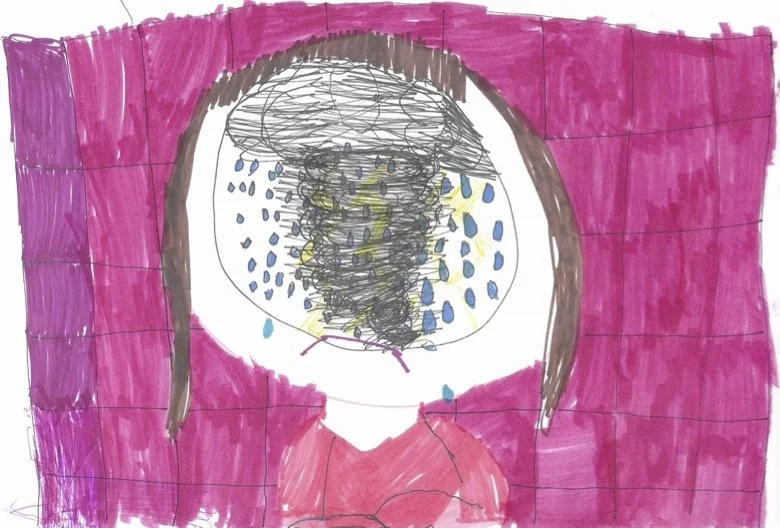
Illustration by Wren.
Kiya’s mom is smiling when Kiya walks out of school and hugs Kiya, asking, “How was your day, sweet girl?” Kiya mumbles, “Good,” but then she cries three times on the ten-minute walk home and she can tell by the time they get there that she’s making her mom mad. Kiya hates making her mom mad, but she doesn’t know how to stop it, and that makes her madder, the wind and rain inside Kiya starting to spin into a baby tornado.
They’ve barely been home five minutes, her mom in the kitchen washing dishes and making a snack, when Kiya accidentally pulls too hard on their dog Stella’s fur. Hearing their dog cry out, Kiya’s mom snaps at her from the kitchen, “Kiya! Leave Stella alone!” And that’s when the storm breaks.
Kiya runs upstairs to her mom’s bed, the mad and sad feelings so big and charged, Kiya’s body becomes a small cloud trying to hold back a raging thunderstorm. Lightening cracks. Kiya screams at the top of her lungs while swinging her fists down to hammer on her legs, “I hate myself! I hate myself! I hate myself!”
Thunder booms and Kiya bursts into sobs. She pulls at her hair hard enough to rip out strands of it and then moaning, scratches at her face and neck with her fingernails. Kiya screams, cries, hits, kicks, and claws as the storm bursts from her like a cyclone ready to destroy a city. Kiya thrashes on the bed, head, fists and feet bashing the quilts and pillows beneath her, her whole body arching up and down like a small boat on enormous waves.
Kiya is barely aware that her mom followed her upstairs and now lays quietly on the bed beside her. Kiya doesn’t hear her mom’s slow, long breaths as if she’s hoping her calm body will help Kiya’s body know that she’s safe. Kiya can only hear the sounds the storm makes as it rips from her body, Kiya at once the wild storm and the lone little girl in the middle of it.
All storms, even the most terrible and destructive ones, stop eventually.
Kiya’s sobs and screams become quieter tears and sniffles. She takes one long shaky breath. “I know you don’t like to be held or hugged when you’re upset, but can I put my hand on your back?” her mom asks. Kiya nods wordlessly from where she is, face down in the pillows. They lay like that for a few minutes, Kiya still catching her breath.
“Do you want to talk about it?” Kiya’s mom asks. From within the pillows comes Kiya’s muffled, “Yes.”
“Do you really hate yourself?” Kiya’s mom asks her, voice soft and gentle. Kiya rolls her face and body towards her mom, who softly brushes hair away from her face, asking if the touch is okay. It is.
Kiya hesitates before responding, “I don’t know. It’s just...I don’t like being Autistic.” “What is it about being Autistic you don’t like?” her mom asks.
Kiya takes a deep breath, holds it, then lets it out. “I feel like I do things wrong all the time. Sometimes I make a mistake, try to fix it, and feel like I can’t. I don’t know how to do things, and I feel like I should know how to do things. Sometimes when I’m upset it makes other people upset which makes me feel like being upset isn’t okay. I always feel like I’m doing something wrong. When I cry people tell me what I’m crying about isn’t a big deal, and I feel bad for crying. Sometimes, people get mad at me for my feelings and it makes me feel like a bad person.” She pauses. “And, I don’t have any friends.”
“Wow,” says her mom after a pause. “That’s a lot. That all sounds very hard. I can see how being Autistic can feel badly sometimes. I wonder though...” her mom trails off, staring up at the ceiling. Kiya puts her head on her mom’s shoulder, something she almost never does, and her mom kisses her forehead.
“I wonder how much of what makes being Autistic hard is because the world around you makes it hard. I wonder how much of what makes it feel bad is because the people around you, even me sometimes, don’t understand you, think you should be different, and make you feel bad.”
All day long the elements for a storm gather inside Kiya’s brain and body: the loud noises, too many bodies, the unwanted smells, tastes and touches, the social expectations needing Kiya to be different, Kiya’s constant confusion, and the never-ending messages that Kiya is different, other, and bad. The storm can only stay inside her for so long, and Kiya can’t control when it breaks loose or what she does when it consumes her.
“Is this okay?” Kiya’s mom asks as she runs her fingers through Kiya’s hair. Kiya nods, not meeting her mom’s gaze. They are quiet together for a long time, lying beside each other, nestled safe and sweet.
“I’m sorry, honey,” her mom finally says. “I hope you know that none of this is your fault. You are doing the very best you can, and most days what’s asked of you is way too much. It isn’t fair, and it isn’t right. The problem is the world you were born into, never you my sweet girl. You’re told in so many ways every day that you are wrong, so of course you feel wrong, but I promise it’s not true. There is nothing wrong with you. I don’t know how we’ll make it better, but we’re going to try.”
Kiya’s body has relaxed, and her brain has reset. Nothing is too big inside her and she can easily think again. “I do like that I’m Autistic a lot of the time. Just not all the time,” Kiya says into the calm surrounding her. “Good,” her mom answers. “I like that you’re Autistic too.“ Kiya’s mom squeezes Kiya tightly to her side once and lets go.
“I farted,” Kiya whispers and loud bursts of laughter break the quiet in the room. “Ewwwww!” her mom shrieks. “You’ll have to call an ambulance when I pass out from the fumes!” her mom teases as Kiya lets her tongue loll out, pretending that she’s dead. Her mom grabs her in a sudden, fierce hug. “I love you exactly as you are and more than you could ever possibly imagine,” she declares. “I know, Mom,” Kiya answers with an eye roll. “Can you tickle me now?”
And as her mom tickles her, Kiya squealing in delight, the sun comes through the fading clouds and beams in the bright blue clear sky. The air is still and the world inside Kiya is calm. For now.
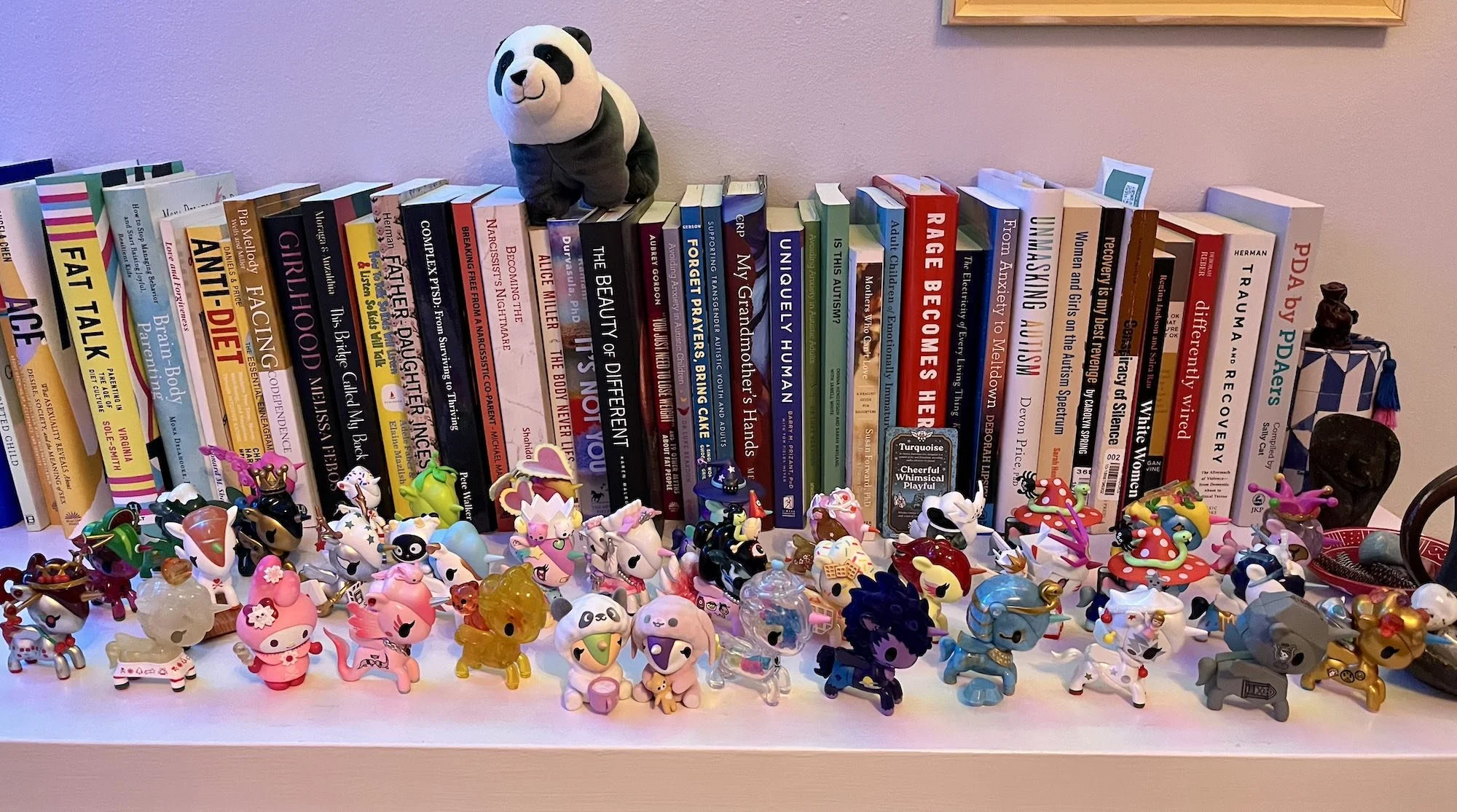
An Email I Sent the School and District
This email was sent in April 2025, when I escalated ongoing concerns about my child’s safety and wellbeing at school to district officials.
The text appears as originally written except for minor redactions to protect privacy.
Since my daughter was in kindergarten, I have been doing everything I can to advocate for her needs at school. I’ve offered education about Autism, been transparent about her struggles, and explained—again and again—that the pain and exhaustion she experiences at home are the direct result of how much she is suffering at school.
Each time, what we’ve been offered is a review of her 504 accommodations and minor adjustments to how her breaks are managed throughout the day. It has never been enough. My daughter is drowning at school. She is barely surviving her school day through sheer grit and determination.
I’ve been telling the school this for two years. Her dad, has told you. She, in her own ways, has told you. Look at her absences over the last two years. But it’s as if you see a child treading water, smiling at you—because that’s what masking is—and you shrug and say, “She seems fine,” and walk away while she drowns. At this point, it no longer feels like a lack of understanding. It feels like willful disregard for what I’ve shared.
This email was sent in April 2025, when I escalated ongoing concerns about my child’s safety and wellbeing at school to district officials.
The text appears as originally written except for minor redactions to protect privacy.
Since my daughter was in kindergarten, I have been doing everything I can to advocate for her needs at school. I’ve offered education about Autism, been transparent about her struggles, and explained—again and again—that the pain and exhaustion she experiences at home are the direct result of how much she is suffering at school.
Each time, what we’ve been offered is a review of her 504 accommodations and minor adjustments to how her breaks are managed throughout the day. It has never been enough. My daughter is drowning at school. She is barely surviving her school day through sheer grit and determination.
I’ve been telling the school this for two years. Her dad, has told you. She, in her own ways, has told you. Look at her absences over the last two years. But it’s as if you see a child treading water, smiling at you—because that’s what masking is—and you shrug and say, “She seems fine,” and walk away while she drowns. At this point, it no longer feels like a lack of understanding. It feels like willful disregard for what I’ve shared.
At her fall conference, I addressed with a classroom teacher the fact that she asks my daughter if she can wait when she asks to use the bathroom. I explained that, as an Autistic child, my daughter has an underdeveloped interoceptive sense—she doesn’t feel the signals in her body until they are urgent. She doesn’t know she’s hungry until she’s starving. She doesn’t know she needs to pee until she’s about to wet her pants.
The teacher explained that she encourages kids to use the bathroom during more convenient times between classes. I said frankly: my daughter cannot do that. Then she said that if she asks her to wait, my daughter can say no and she’ll let her go. I explained that my child wants to please adults and won’t say no.
Despite all of that, the teacher looked at my daughter and said, “If I ask you to wait, you can say no if you really can’t wait. Can you do that?” And of course, my daughter said yes. After we left, I asked if she really meant it. She said no. She just didn’t want to talk about it anymore.
I share this not to single out this teacher, but because this is representative of the larger issue: you are not listening. Not to me. Not to her dad. And not to her. This is not a teacher problem. This is a systemic issue that has impacted my daughter since she started kindergarten. It spans multiple years, multiple staff members, and multiple conversations where I have done everything I can to help you understand her needs. And still, she is not getting the support she needs to be safe, regulated, and well at school.
I’ve explained that my daughter will always appear well-behaved at school. She is a high masker. I’ve described, in multiple meetings, how the cost of her needs not being adequately met at school shows up at home. I’ve shared openly and transparently about those costs. And still, you are letting her drown while telling yourselves she’s fine—because she looks fine to you.
That’s the essence of masking. She will always look fine to you. The distress is happening internally.
My child goes to the nurse’s office regularly—sometimes multiple times a day. This is one of the few places in the building where she can try to find relief. She is doing everything she can to care for herself in the absence of adequate support. The frequency of these visits is not incidental. It is communication. It is a coping strategy. It is also a red flag. And yet, it has not prompted meaningful change.
If you had a student who, during a meltdown, was ripping out hair, scratching her face and neck until they bled, hitting herself with her fists, arching her back and sobbing uncontrollably—you would respond with urgency. You would change the environment. You would ask, "How do we stop this child from suffering so deeply?"
Well, that is my child.
You don’t see the behaviors because she holds them in all day until she gets home. But the suffering is real. How many of your 7-year-olds have made a noose and said they want to die?
Let me be clear: my child’s suicidal gesture this fall is directly related to the ongoing distress she experiences at school. This is not coming from what she experiences at home, where her needs are met in real time, she has autonomy over her body, and she can safely name her experience. It is school that is wearing her down.
For two years, I’ve raised concerns that my daughter may have a learning disability. I requested an evaluation in Fall 2023. I was told she wasn’t far enough behind academically and that request was denied. I’m not an educator—but I know Autistic kids. I know twice-exceptional kids. It is not unusual for Autistic children who are highly intelligent to mask over a learning disability so completely that it never gets identified.
You cannot determine how my daughter is doing based only on the output you see. She is struggling. And I am tired of asking for help, of begging for someone to take that seriously.
She’s missing school not because she’s oppositional, but because she is burned out. My 8-year-old is experiencing Autistic burnout because the school continues to prioritize minimal accommodations over real, meaningful change.
My daughter doesn’t just need a revised list of supports. She needs the school to understand that the environment itself—the structure, the assumptions, the norms—is neurotypical by design. It is hurting her. She needs you to recognize how courageous and strong she is for surviving a school day that is, for her, a gauntlet of distress, confusion, and pain.
I’ve come into every meeting and conversation hoping that if I explained things clearly, you would understand. But it’s become clear that there is a lack of foundational understanding about Autism, about ableism, and about what anti-ableist practice actually requires.
I am a single mother. I do not have the time, money, or resources to pull my daughter from her neighborhood school and place her in a specialized setting. I shouldn’t have to. But I know many parents who’ve had to make that choice—not because their children failed school, but because school failed their children.
Given the ongoing concerns and the lack of adequate response at the school level, I am now bringing this matter to the attention of district officials, including the Section 504 Coordinator, Civil Rights Coordinator, Title IX Officer, and Superintendent. I hope this will prompt a more comprehensive and effective approach to addressing my daughter's needs.
You are failing her. She is suffering. And whether intended or not, the school’s ongoing failure to act in response to her needs amounts to disability discrimination.
I am asking you to start responding to my daughter’s needs with the urgency you would show if her distress were visibly erupting in the classroom. Her pain is no less real because she keeps it hidden.
And for the love of god—please stop asking her to wait when she says she has to use the bathroom. Even when she says yes, she means no. She can’t wait. Please trust her with her body. That is a basic form of dignity and respect every child deserves.
My daughter is not a neurotypical child. She does not need help building resiliency—she is resilient. She has to be in order to survive an average day at school. What she needs from you is not more pressure to cope, but a deeper understanding of her neurodivergence and a genuine willingness to change the environment to meet her needs. That is what true inclusion looks like. And that is what she deserves.
Sincerely,
Stacey
aka, mom
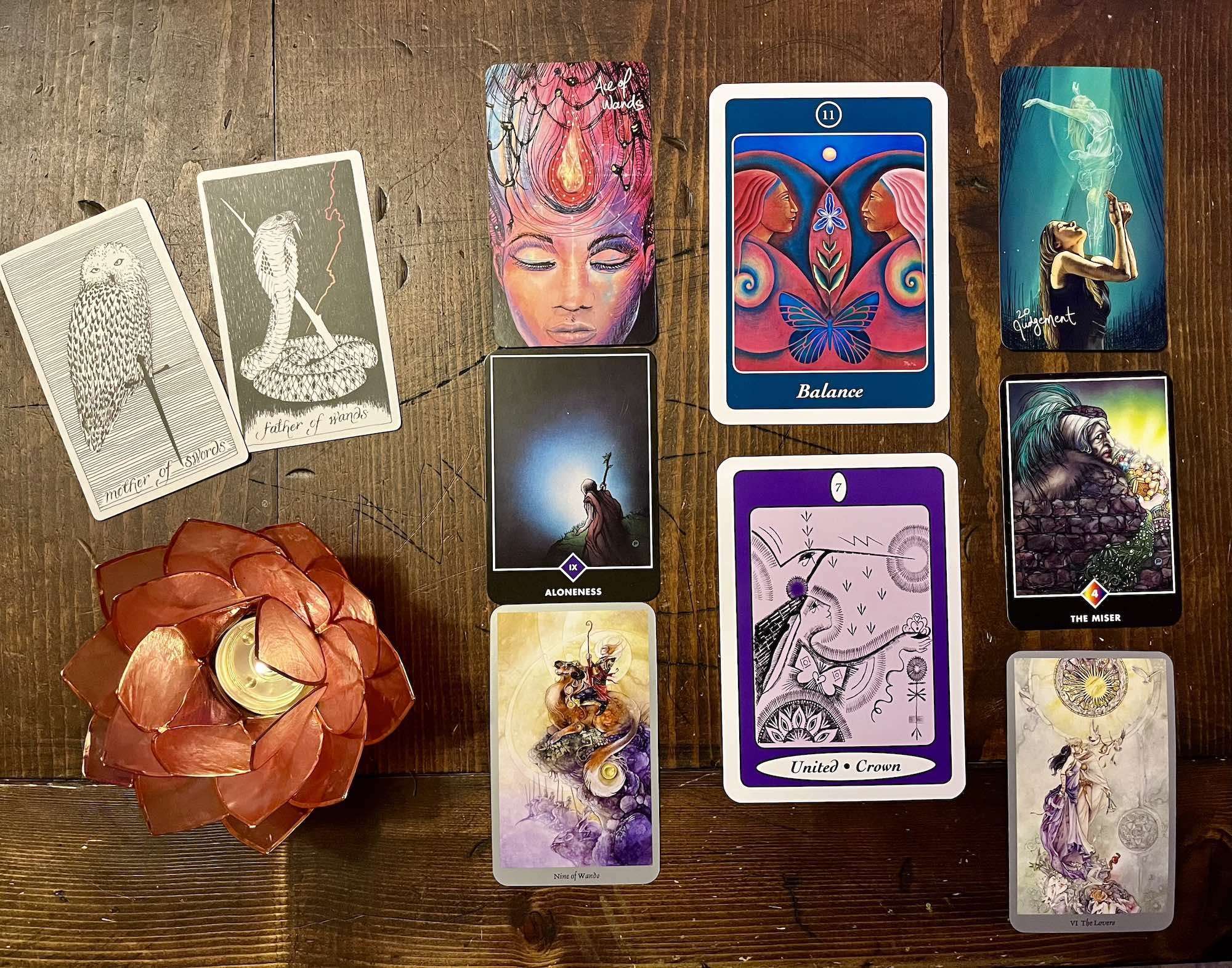
Am I Safe Now? Will I get what I desire?
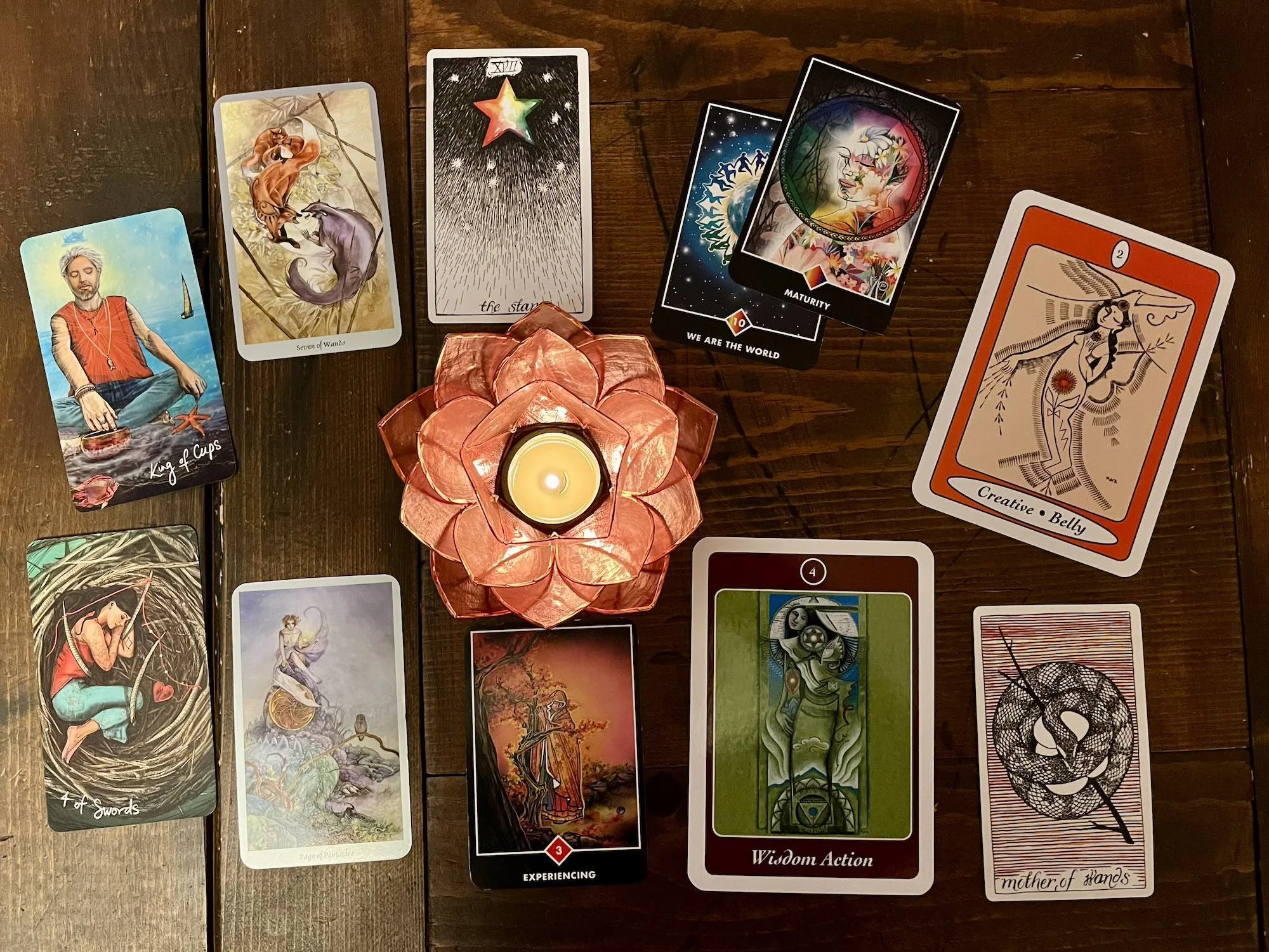
Am I Safe Now?
1. King of Cups, Light Seer’s
2. Seven of Wands, Shadowscapes
3. XVII The Star, Wild Unknown
4. 10 of Rainbows/We Are The World, Osho Zen
5. Ace of Rainbows/Maturity, Osho Zen
6. 2 Creative/Belly, Rainbow Warrior
Will I Get What I Desire?
7. 4 of Swords, Light Seer’s
8. Page of Pentacles, Shadowscapes
9. 3 of Fire/Experiencing, Osho Zen
10. 4 Wisdom Action, Rainbow Warrior
11. Mother of Wands, Wild Unknown
Formal Complaint of Disability Discrimination
This is the introductory letter to a formal disability discrimination complaint I submitted to the school district on behalf of my child in May 2025.
The text appears as originally written. Minor redactions have been made solely to protect privacy.
May 2025
Re: Formal Complaint of Disability Discrimination on Behalf of My Daughter
Dear District Official,
I am writing on behalf of my daughter to file a formal complaint against her elementary school and district for disability discrimination under Section 504 of the Rehabilitation Act of 1973 and the Americans with Disabilities Act (ADA).
This complaint outlines the specific failures of her school and district to provide legally required disability supports, and documents the resulting educational exclusion and psychological harm my child has endured.
This is the introductory letter to a formal disability discrimination complaint I submitted to the school district on behalf of my child in May 2025.
The text appears as originally written. Minor redactions have been made solely to protect privacy.
May 2025
Re: Formal Complaint of Disability Discrimination on Behalf of My Daughter
Dear District Official,
I am writing on behalf of my daughter to file a formal complaint against her elementary school and district for disability discrimination under Section 504 of the Rehabilitation Act of 1973 and the Americans with Disabilities Act (ADA).
This complaint outlines the specific failures of her school and district to provide legally required disability supports, and documents the resulting educational exclusion and psychological harm my child has endured.
I am intentional in not softening my tone to make this letter more palatable or easier to read. I write it from a place of pain, and I want that pain to be felt. As you read this, I ask that you resist the reflex to protect yourself—through dismissal, denial, or disconnection. I ask that you stay with the discomfort you feel in your body. I promise: it is nothing compared to the literal pain and trauma my beautiful child suffered in her body during 3 years under your care.
It is widely known and easily accessible information—if you look—that high-masking Autistic children perform conformity while silently suffering, often with delayed or hidden signs of distress. These children suppress the very movements, sounds, and behaviors that help regulate their nervous systems in order to meet neurotypical expectations. When schools like hers fail to understand this pattern, children like my daughter are overlooked, invalidated, under-resourced, improperly supported, and deeply harmed.
What follows in these pages is a detailed accounting of the distress my daughter experienced over the course of almost three years at school—distress that was continuous and worsening between winter of her kindergarten year until spring of second grade—and the repeated efforts her father and I made, which ultimately failed, to educate, advocate, and request appropriate and adequate disability supports. This is a case, laid out in full, against a school and school system that refuses to recognize disability needs when they don’t appear in expected or familiar ways. A system that withholds meaningful care and intervention from children even when those children clearly show they are struggling, and that causes egregious harm while denying that harm is happening at all.
What follows in these pages is my righteous anger as a mother exhausted from trying to single-handedly force care for my child into a system that repeatedly minimized, gaslit, and dismissed us—and that never took accountability, never apologized, and never sought to repair what it broke.
What follows is my love for an extraordinary child who deserves safety in a system she has a civil right to access—a system that ultimately denied her that safety and told her, again and again, that there was no reason she shouldn’t feel safe.
What follows is the story of a now eight-year-old, high-masking, Autistic ADHD girl who entered kindergarten excited to start school—who loves her friends and loves learning—and who was traumatized by her school in less than three years.
After two years of tireless labor—working respectfully and openly within the system, believing that care and understanding would eventually lead to meaningful support—I have learned that the school and district do not care about children like my daughter. That lack of care is not imagined or subjective; it is documented in the pages that follow. It is visible in the systemic neglect, ableism, and willful ignorance that allowed harm after harm to be perpetuated against a child no one at her school ever truly took the time to know.
Here is a powerful truth I’ve learned: I cannot make you see the harm you’ve caused if you don’t want to. I cannot force you to face the truth. I tried for two years to help school staff and administration understand how they were actively, even willfully, hurting my child while she was in their care. They consistently acted as though her pain and suffering were invisible—right up until the very end.
I was transparent about how her distress showed up: the lying that led to urgent care visits, a chest X-ray, and prednisone; the daily afterschool meltdowns that sometimes lasted all evening; the violent morning refusals; the self-injury; the suicidal gesture; the weakened immune system; the chronic nausea and fatigue. She showed them, again and again, through frequent nurse visits, school refusal, absences, and tardies—spanning two years. Still, they refused to see it.
And then, at the end of it all, after two years of her pain demanding to be believed, a school staff member said, “If she’s really felt like this in my classroom this whole time, I feel awful.” That IF is the crux of the blindness that denied her care. That if is how her disability was erased. My daughter was never believed. We were never believed.
I cannot force you to see the truth, even when it’s held directly in front of you. But I can make our truth part of a written record that will outlast your denial. I can place our truth in the hands of future leaders who are willing to reflect on the blind spots their ableist privilege affords them—leaders whose care is genuine, whose efforts are grounded in the hard labor of dismantling systems that cause harm.
The school engaged, over the course of three years, in active, repeated, and blatant disability discrimination against my daughter, a student in their care. That discrimination ultimately prevented her from accessing a free and appropriate public education, as is her right under the law.
The kind of hostility my child faced at school—staff and administration—is the kind that’s easy to deny. It wears the mask of politeness. It presents as smiles, niceties, and care, while offering no real care at all. It looks like effort, while no meaningful effort is made. It looks like meeting a child’s needs, while refusing to truly see or understand them. This is the kind of hostility that systems are built to overlook—because if it isn’t happening to you, your privilege means you don’t have to notice.
This is what disability discrimination looks like in real life. It isn’t always obvious or easy to name, but in this case, it is undeniable. It is visible in the patterns, the omissions, the refusals to act. It’s in the way my child’s needs were minimized, her distress dismissed, and her disability denied because it didn’t conform to expectations.
I want to be clear: what my child—and we, as her parents—faced during her three years at school was not passive. It was not a matter of ignorance or insufficient training about Autism. It was active and repeated harm, enacted through the dismissal of pain, minimization of suffering, neglect of care, and refusal to provide adequate disability support. My child did not perform disability in the way the school team expected, so her disability was denied. Even at the very end, we were reassured that she “really is a model student”—a statement that perfectly encapsulates the problem.
We are asking the district to conduct an investigation into the matters outlined in this complaint. We seek full accountability for the disability discrimination my daughter endured over the past three years at school, including a clear plan for how the district intends to make restitution and repair the trust that was broken. We are also requesting a written apology and formal acknowledgment of the harm caused. Additionally, we request that the district provide support in determining an educational path forward that meets my daughter’s needs in a safe and affirming environment. Finally, we ask for a district-wide plan of action to address the implicit ableist bias that allowed this discrimination to continue unchecked, and to ensure no other child experiences what she did.
My daughter is not the only high-masking Autistic child suffering in your schools. Hers is the only story I carry, but we share it on behalf of all of them.
In her own words, from the statement she bravely read during our final meeting at school: “Please do take this seriously.” This is not just a formal complaint. It is her testimony.
Sincerely,
Stacey
aka her Mother
An Email I Sent My Family
Content note: This email contains discussion of childhood sexual abuse.
I sent this email to my parents and siblings four years ago. What I know of my trauma history has changed since then, as I’ve become a more faithful listener to my own experience and to my body.
This email marks a step on a path I will always be walking, and I share it as such—a record of where I was then, on my way toward fuller truth.
I insist on making one clarification here: I do not love the men who abused and raped me, nor the adults who colluded to cover it up and silence me.
Everything else remains as written, even where my understanding was incomplete. I share it as an honest record, not a final account. The only changes I made to the email text were minor redactions for privacy.
There was a time when I felt faced with an impossible choice: myself and the truth, or getting to have a family. I made the only choice I could. I share this email to honor the version of me who wrote it — and to stand with anyone who’s had to make the same choice.
Hi Family,
I hadn't been planning on doing this now, but a spark of fury drove me
to start this email Monday morning. I kept writing after the fury
passed and noticed that it felt good. It feels good to recognize that
I'm safe enough to speak my truth. This email is about the sexual
trauma I experienced as a child. It's a doozy so please take care of
yourself while reading it.
Content note: This email contains discussion of childhood sexual abuse.
I sent this email to my parents and siblings four years ago. What I know of my trauma history has changed since then, as I’ve become a more faithful listener to my own experience and to my body.
This email marks a step on a path I will always be walking, and I share it as such—a record of where I was then, on my way toward fuller truth.
I insist on making one clarification here: I do not love the men who abused and raped me, nor the adults who colluded to cover it up and silence me.
Everything else remains as written, even where my understanding was incomplete. I share it as an honest record, not a final account. The only changes I made to the email text were minor redactions for privacy.
There was a time when I felt faced with an impossible choice: myself and the truth, or getting to have a family. I made the only choice I could. I share this email to honor the version of me who wrote it — and to stand with anyone who’s had to make the same choice.
Hi Family,
I hadn't been planning on doing this now, but a spark of fury drove me
to start this email Monday morning. I kept writing after the fury
passed and noticed that it felt good. It feels good to recognize that
I'm safe enough to speak my truth. This email is about the sexual
trauma I experienced as a child. It's a doozy so please take care of
yourself while reading it.
The timing of this email doesn't seem ideal with the holidays next
week. I considered not sending it because I don't want to have a
negative impact on your Thanksgivings, especially with it being
our nephew’s first. I'm sending it anyway because I’ve already waited too
long to be safe enough to say this. The cost of not having been safe
enough sooner (like when the traumas happened or the years immediately
after) is grave and profound. Recently, in really painful moments on
the hardest days, it's felt like it's cost me most of my life.
I don’t believe Mom or Dad sexually abused me. I never accused either
of them of doing so, and I’ll get to that in a moment.
I expect reading this email might be hard. In sharing what I know of
what happened to me, I hope to free myself from the burdens of secrecy
and denial that have restricted and lessened my life. I write with no
meanness or anger, the fury that sparked this email has long since
passed. I strive to be honest and kind. But I’m also not going to take
care of you here. Child rape is awful. Reading about it is awful.
Living with it is awful. This is painful. It's okay if it causes you
pain.
First, I want to address any lingering misunderstandings or
misrepresentations of the events that led to my estrangement from Mom
& Dad in 2016. I went to Mom & Dad and asked for their help in healing
work I was doing around trauma symptoms that were impairing my life. I
was getting closer to material related to early childhood sexual abuse
and incest, but it was muddled and confusing. I don't have cognitive
memories of my abuse (as is commonly the case when the abuse happens
so young), and back then I didn't trust my own knowing like I do now.
I was very clear with Mom & Dad during that conversation that I was
not accusing anyone of anything. I said those exact words multiple
times. I said I didn’t know what happened to me. I also said there are
things about how I experience myself that suggest incest and early
childhood sexual abuse are part of my past. I said I suspected my body
had been violated, but I also said I didn’t know that for sure. I said
it's possible I didn't experience direct abuse but the effects of
trauma that happened in an earlier generation (intergenerational
trauma). I said maybe something happened to me at daycare or by
someone outside the family. I said many times and in lots of different
ways that I didn’t know what happened to me. I was not angry during
the conversation. I was very open and vulnerable. I came to them,
opened up, and asked them for help.
Unbeknownst to me at the time, both Mom & Dad left that conversation
believing I had accused them of sexually abusing me as a child. Mom
attacked me viciously and meanly over text later that night. It was
terrible. Her response was rageful and violent. Dad was completely
silent. I protected myself by setting a no contact boundary that Mom
then repeatedly violated over the next couple years. I'm not saying
any of this to shame Mom or Dad, but to simply report the facts of
what happened.
My healing work didn’t stop because of their reactions. To the
contrary, I took their reactions as support that incest and early
child sexual abuse is part of this family. People who have no reason
to be so defensive aren’t. I understand much better now the power and
viciousness of denial and how aggressive it can be in the face of
unwanted truth. I've been dealing with it inside myself a lot lately
and it's taught me what a powerful force it is. I don't blame Mom &
Dad. I've forgiven them and re-established what relationships I can
with them. I love them, and I hope they know that.
I now know that I was raped as a child. I'll say it again because it's
worth repeating. I was raped as a child. I was younger than 5 when it
happened. I suspect I was younger than 4. I was terrorized and I was
traumatized. My perpetrator was a family member, someone inside the
same house as me. I believe that person to have been Grandpa Dave. I
don't know how many times, how old I was when it started, what exactly
was done to my body, or when it stopped. I do know that it hurt, that
I believed he might kill me, and that it was impossible to live with
the knowledge that someone who loved me (because he did love me) could
hurt me so badly and seem to enjoy it. This last bit has been at the
heart of the terror I've lived with ever since.
Early last fall I found myself once again seized by an experience of
nighttime terror that has plagued me since I was a child. Every night
I lie in bed in a freeze state (a trauma state that happens when fight
or flight fails to get you to safety). Every muscle in my body locks
down and terror floods my system. My whole life I have waited in the
dark for an unknown sadistic man to come into my room, torture, and
kill me. Gripped by terror, I wait to hear his footsteps on the
stairs. I expect to see him over my bed any moment. My body braced, I
wait with no doubt that he's coming. A part of me is always convinced
I won't live to see morning. It's like living inside horror and I have
spent thousands of nights like this over the course of my life.
This terror experience visits me in waves. It comes into my life and I
live consumed by it for some months before it dissipates. I've
barricaded myself into many rooms. I've slept with knives under my
pillow or bats by my bed. I've lost untold night's of sleep. There was
a season in my early 30's when I waited every night until the sun rose
to try to sleep.
When it came back last fall I brought it into my therapy and healing
work in a way I never have before. It's been such a regular experience
for me that I didn't realize how terrible it is until I started
really sharing about it and paying attention to it. At first, I just
wanted to make it go away. It was really upsetting to realize I
couldn't. Then, I recognized it as trauma. It seemed silly because I'd
known I have PTSD for years, but suddenly one day I thought, "Oh,
fuck. This is PTSD." I'm not crazy; I'm traumatized. That's when I
became willing to listen.
I have spent the last year befriending my nighttime terror experience
(as much as one can befriend something so fucking awful), tending to
myself around it with love and care, and learning to listen to what my
body has to tell me. While my mind doesn't remember the ways I was
terrorized, my body remembers everything. I realized by listening to
my experience that the sadist I've been waiting for was already inside
the house with me. I learned that I'm not afraid something is about to
happen--despite my mind presenting it to me that way--but reliving
something that has already happened. I see with stunning clarity now
something so blindingly obvious, but that my own denial mechanisms
shielded me from for a very long time: the place where I feel the most
unsafe in the whole world is my own bed, inside my own house, at
night. This is the seat of my terror and trauma.
As a young child in my bed at home, I would lie in a freeze state at
night, my body paralyzed, flooded with terror, while I waited for men
to break into the home and kill us. I used to fall asleep with a book,
my hand, or a stuffed animal over my heart imagining it would stop a
knife or bullet. I used to practice holding my breath so that when one
of these men came into my room they would think I was already dead. I
was a traumatized child. I now understand that my mind created the
image of killer men to make sense of the terror in my body. I
understand that as a child I made the men into outsiders because I
couldn't survive knowing the person who terrorized me was welcome in
the house and someone I lived alongside during the day.
As a child I knew I was not safe in my own bed in my own house at
night. This was true, and I knew it, even when I didn't know why. I
was not safe in my own bed in my own house at night. I went to bed
alone as a child feeling this and lay there terrified. I don't know
when the abuse stopped. When it did stop, I had no way of knowing it
wasn't going to happen again. I have gone to bed every night of my
life since waiting for it to happen. I still wait. I'm 43 years old
and every night my body waits for him.
Growing up, I experienced this nighttime terror in only 2 places: my
bed at home and in the basement of our grandparents’ house. To this day,
I can't sleep in the bedroom in the basement of my own home without
going into a panic attack.
I am still uncovering the truth of what happened to me as a child, but
I am uncovering it. My body is informing me and I am now listening to
it and believing what it tells me.
Back in 2016 all I did in that conversation with Mom and Dad was tell
the truth, and that’s all I’m doing again today. For families carrying
a legacy of incest and early childhood sexual abuse, telling the truth
can seem to some like the worst thing a person can do. It can erupt
all kinds of defenses against knowing the truth and lead to
scapegoating of the person telling the truth. Mom and Dad scapegoated
me in 2016. As I said earlier, denial is powerful. It can also be
violent and mean.
You each get to choose what you do in response to my truth. I have a
lot of empathy and understanding about how my truth might cause you
pain, but I accept no fault or blame for that pain. When a child is
abused and reports it, the child is not to blame for the pain learning
of the abuse causes her loved ones. It’s the same here. I’m not the
cause of your pain. The people in our family ancestry who abused and
sexually violated children are. The man who raped me is.
The impact this email has on you is yours to deal with and live with.
I have to live with rape. I was the victim of a pedophile as a little
girl and I was neglected by parents who refused to see the signs that
I'd been abused, and there were many signs. If my family wants to keep
refusing to see it, I can't do anything about that. Thankfully, your
denial doesn't hurt me anymore. I don’t need your belief. I have my
own.
I don't really care what you choose to do with this information or my
story. I'm done carrying it as a secret and that’s all that matters to
me. I won't tolerate mistreatment or abuse from you though. I don't
tolerate it from anyone. If you want to engage with me in conversation
about this, I'm happy to do that and I expect that conversation to be
respectful and kind. I have a lot of capacity to show up with you in
this, but you have to be willing and able to show up well. If you
can't, I invite you to do some of your own work. Feel free to come to
me anytime in the future when you can meet me as well and respectfully
as I can meet you.
I also invite you to take your time before responding to me. I don't
need immediate replies. I'd rather you take whatever time and space
you need to process this and feel all the feelings you have about it
before coming to me. If you do come to me about this, please do so
privately (no reply all’s to this email) and be kind. Despite all I
shared in this email, you really have no idea what I've lived through.
I love every person in this family. I love Grandpa Dave. I love
myself most of all.
I dedicate the sending of this email to my daughter. May the children in this
family live free from the trauma and terror that's come before them.
I offer a special prayer to Mom: May my healing work bring you peace.
Stacey
Love Letter 25: Exile, Despair, Love
Darling [Recipient’s Name],
You are loved far out beyond what you can think and feel. It will surprise you in the wildest, most wonderous places. That part of you who others will surely look down on for how unskillful, unenlightened, and much further behind she is. The part who has too big feelings far too frequently. The messiest, ugliest, and meanest parts. The ones with so many desperate needs. The part who says, “No.” The one who asks for exactly what she wants and doesn’t feel ashamed. The part of you perpetually afraid she’s not enough of what They want.
Wherever the hurt is most exquisitely tender. Where the tears threaten to never stop. Where it feels like agony. Out where you wail, and out past that where you rage.
Darling [Recipient’s Name],
You are loved far out beyond what you can think and feel. It will surprise you in the wildest, most wonderous places. That part of you who others will surely look down on for how unskillful, unenlightened, and much further behind she is. The part who has too big feelings far too frequently. The messiest, ugliest, and meanest parts. The ones with so many desperate needs. The part who says, “No.” The one who asks for exactly what she wants and doesn’t feel ashamed. The part of you perpetually afraid she’s not enough of what They want.
Wherever the hurt is most exquisitely tender. Where the tears threaten to never stop. Where it feels like agony. Out where you wail, and out past that where you rage.
Into those tight, cramped, craggy, darkest spaces where your aloneness resides alongside your misfits, clowns, outcasts, exiles and whores. Into that spot in your heart where the pain stops you breathing. Where sadness feels a lot like dying and where, for a flash, you sometimes stop wanting to live. Into the places air can barely get. This is where my love will find you.
This is where it has always been waiting.
You don’t have to earn it. You don’t have to come looking for it. It is effortless and free. My love is coming for you everywhere you are. It will find you no matter what, and you can’t ever lose it. I will just keep giving it to you.
There is so much love for you out here. It is everywhere, in everything. There is so much love for you in there. It is everywhere, in everything. I keep pouring it in.
You are Beloved. Not sometimes. Not some parts. The whole, grand, marvelous universe of you. You. Are. Beloved.
I am here, wiping the tear from your cheek. Softly, holding your gaze. Cupping your face in the palm of my hand. I am here, pouring all of my love into you, and I will never stop. My love for you only grows.
My heart,
[Recipient’s Name]